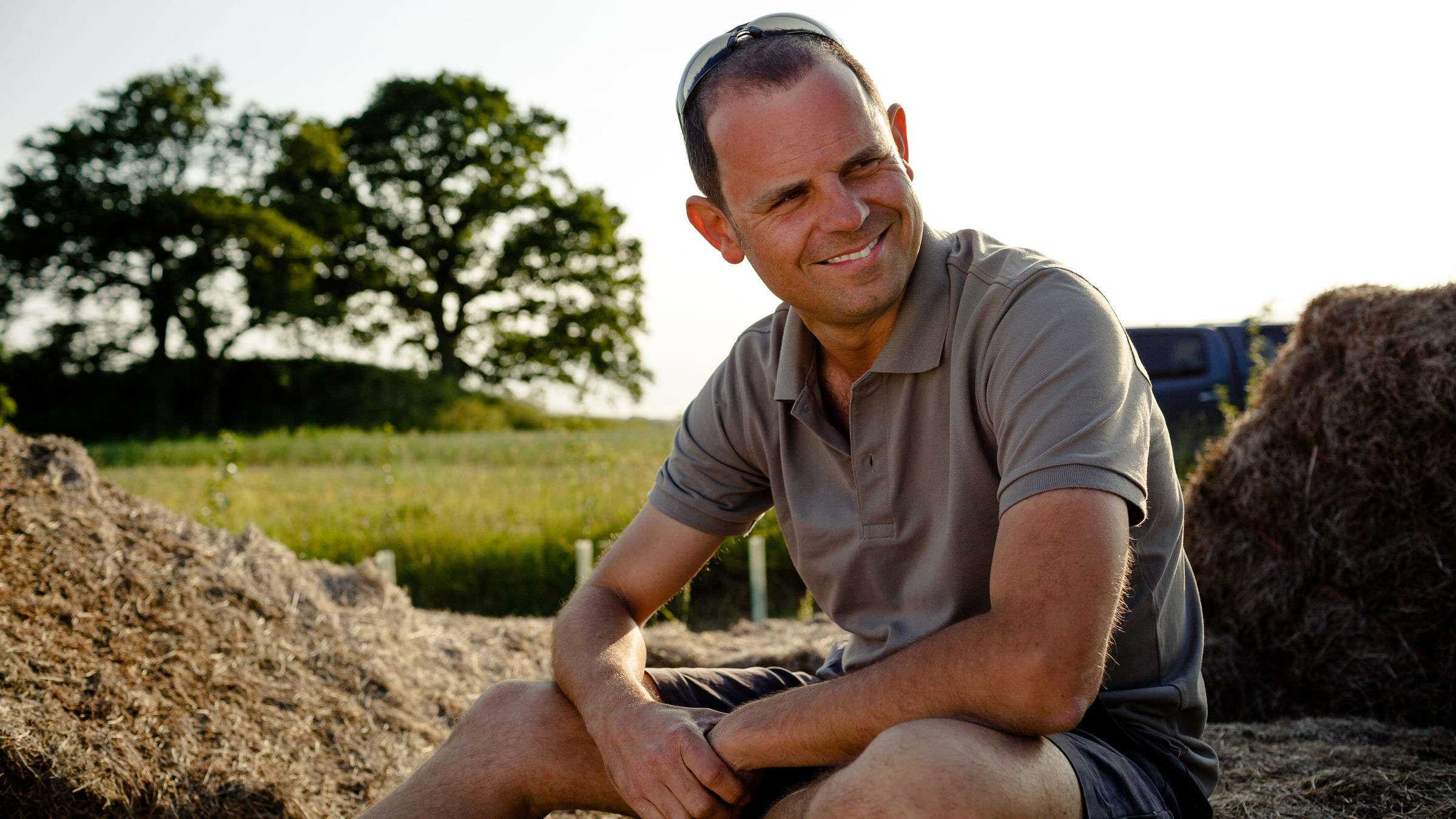
It might not know it yet, but Butness Vineyard, which has been quietly minding its own business at the north-west side of our estate since 2004, is about to become quite the talking point. A hotbed of experiments, challenge and change.
Jon Pollard, our Vineyard Manager, has signed up these six-hectares of vines to the One Block Challenge - a global project to test and learn what works in regenerative farming.
Get your wellies on, this will be worth it
You might not be familiar with regen agriculture – but this is sustainability at its most head-turningly, fist-pumpingly exciting. The goal is massive: to actively restore soil health, rebuild soil organic matter, capture carbon, increase biodiversity, reduce reliance on synthetic chemicals and mitigate climate change. Pulse-racing stuff.
The only downside is that it's a seriously long-term approach. Change takes time. And attention-spans are only so...
... long.
But, luckily for Gusbourne, our Vineyard Manager Jon Pollard lives and breathes this stuff. His thoughtful approach has been challenging the status quo – and pushing what's known and practised in English viticulture – for more than two decades.
So, what's new?
The One Block Challenge is an initiative created by the Regenerative Viticulture Foundation (RVF). The project focuses on a single area of vines, aiming to test out which regen practices work – initially over 12 months.
You establish baselines, make measurable changes, and learn – over time – from what follows. Importantly, it's about sharing ideas and learning from the community of viticulturalists in this space, too. No one is expecting answers overnight.
As Jon puts it: “We’re talking about soil. And soil takes decades to change.” The project is about learning season on season – and acknowledging that what works in one year may not the next.
Focusing on Butness
Jon chose Butness Vineyard for the challenge because: “It’s big enough to be meaningful, but small enough not to waste too many resources if trials don't work out," he says.
The core focus is cover cropping – specifically, how to establish diverse plant species on Gusbourne’s heavy clay soils. Jon is trialling several establishment techniques side by side. These include direct drilling seed beneath the soil surface, mowing existing vegetation extremely short before drilling to reduce competition, and lightly disturbing the soil with a spring-tine harrow before sowing.
Each method is designed to answer a simple question: what actually works here? “What I’ve done in the past is think, right, I’ve got 60 hectares, I’m going to cover crop it all – and then it doesn’t work,” Jon says. “So maybe just go a little bit back to basics.”
Plant choice matters too. Part of the trial focuses on a grass-free herbal ley made up of broadleaf species such as clovers, chicory, plantain and yarrow. These plants are small-seeded and notoriously difficult to establish. “If I can get a herbal ley going and I can do that in most years,” Jon explains, “I can probably get anything going.”
Smaller areas will also be sown with annual species, likely to include phacelia, buckwheat and dwarf sunflowers, which will be left to flower and set seed.
Under-vine herbicide use will remain unchanged for now, as vine vigour is being carefully rebuilt across the estate. Fertiliser regimes will broadly stay consistent, allowing any changes observed to be more confidently linked to soil structure and biology rather than nutrition inputs.
One area where Jon is pushing further is disease management. He plans to increase the proportion of biological fungicides within the spray programme, building on experience from smaller trials elsewhere.
“I enter into this with great caution,” he says. The vines will be monitored closely, with conventional treatments ready if disease pressure rises. There is risk in experimentation. Jon sees that risk as part of doing the job properly.
“If you’re not wasting a certain amount of crop in vineyards or wine,” he says, “you’re not doing your job – because you’re not trying something new.”
Measuring what matters
Jon's established baseline data through earthworm counts, soil infiltration tests and assessments of soil structure. “As allotment owners will know, worm counts are a good indicator of a healthy soil,” Jon says. Meanwhile, water infiltration – which tests the structure and porosity of the soil – has proved a challenge with our heavy, winter-wet clay. The same measurements will be repeated in spring and periodically throughout the year.
“Regen practices are all considered within the context of where you’re growing,” he explains. Soil type, climate and season shape what’s possible. Some years will show progress; others remind you who’s really in charge.
“I think we’ll always be improving rather than arriving,” Jon reflects.
So, as the growing season unfolds, we'll check back in with Butness - what's working; what's not? Test and learn; take a risk; make incremental gains. It's the Gusbourne way.
You can find out more about our approach to farming and working sustainably here.